




Client Sector
Healthcare

Expertise
Construction Materials Services

Location
Lansing, Michigan

Healthcare
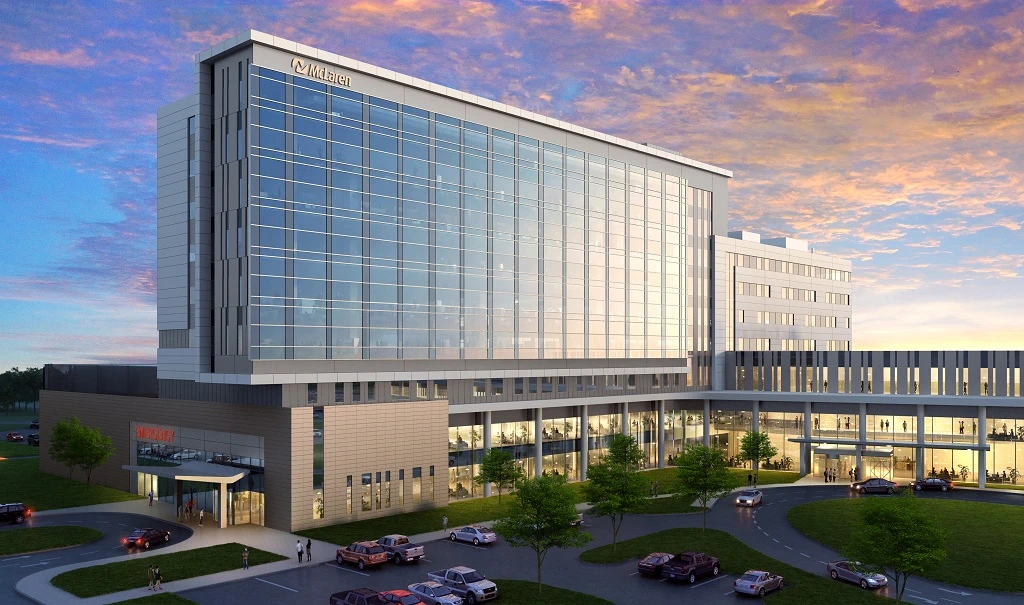
McLaren Greater Lansing Hospital
Partnership and a shared vision for community-focused healthcare guided the development of Michigan’s premier new hospital campus adjacent to Michigan State University. Consolidating two aging Lansing facilities, the project delivered a 750,000-sq-ft, 240-bed replacement hospital with a 180,000-sq-ft cancer center, ambulatory care facilities, and research and education spaces. SME prepared the site, where up to 11 feet of soil was excavated from varied elevations. Because the removed soil had been heavily preloaded, SME recommended pressuremeter testing to directly measure soil strength and compressibility. These results allowed the design team to increase allowable bearing pressures to 10,000 psf in the basement and 6,000 psf at grade, enabling shallower foundations and reducing concrete and re-steel quantities.
SME also performed microtremor array measurements (MAM) and multi-channel analysis of surface waves (MASW) to evaluate shear wave velocities, improving the seismic classification from Class C to Class A and reducing design forces. During construction, SME used 3- to 6-foot-deep dynamic cone penetrometer (DCP) tests at every column pad to confirm that proper compaction with an excavator-mounted hoepac would achieve required capacities without costly undercuts.
For the new Karmanos Cancer Center, SME provided specialized thermal control monitoring for the mass concrete walls and lids surrounding the linear accelerator rooms. These four- to seven-foot-thick, 30-plus-foot-tall concrete elements required strict temperature differential control to prevent thermal cracking that could compromise radiation shielding. SME installed core, perimeter, and ambient probes and used real-time monitoring to guide insulation adjustments throughout curing.
SME also supported major infrastructure improvements along Forest Road, including roadway widening, utility replacements, and a new roundabout. With clay subgrades exhibiting high moisture content, SME performed borings, lab testing, and proofroll observations to identify where discing and drying were needed, reducing undercutting and ensuring stable pavement support.