


Built to Last: A Decision Still Paying Off 35 Years Later
SME | By Mark Kramer, PE | Published on October 21, 2026
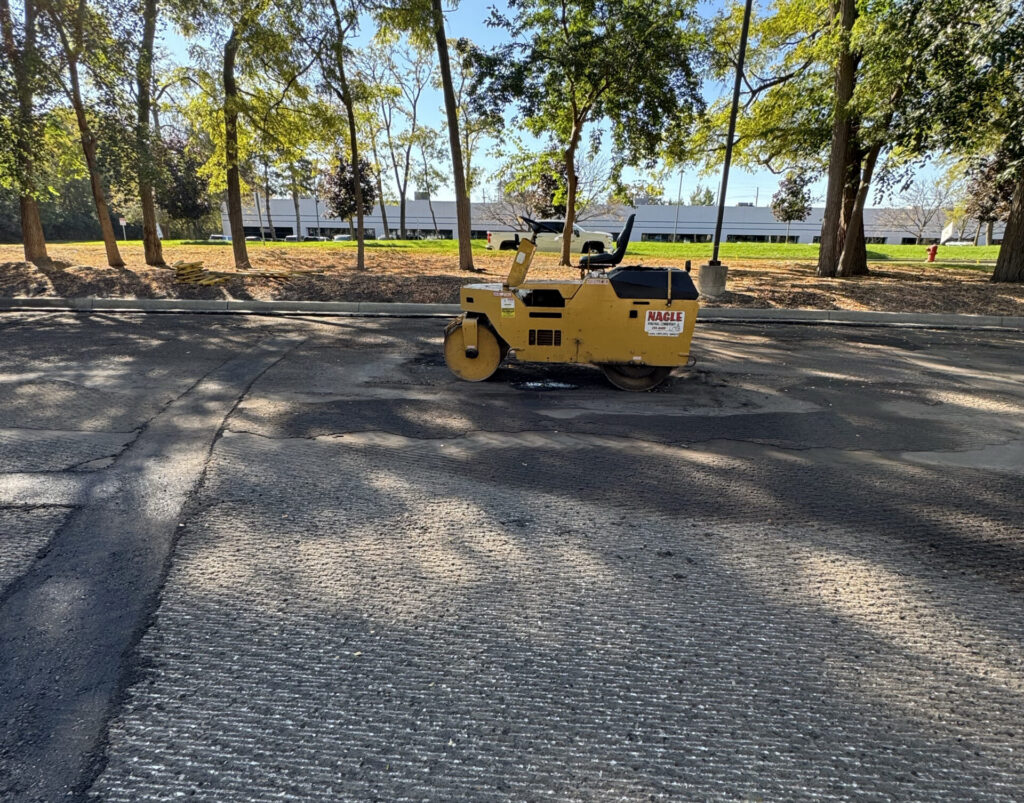
Our Plymouth parking lot is a good example of what happens when you make the right decisions early.
People ask why we can’t make roads and parking lots last longer. We can, but we need the right conditions, and we need to make the right decisions early in the process. In Michigan, we have some of the most challenging conditions for pavements, particularly in Metro Detroit. Our location puts us in a significant freeze/thaw zone across the lower part of the state. We go from below freezing to above freezing more often than areas farther north, where it stays cold longer, or farther south, where it stays warmer. We happen to be in the zone with the most cycles. We also have poorly drained clay soils that are heavily affected by moisture. Together, these two factors can significantly reduce the useful life of pavements.
There are other factors. Heavy truck traffic, using partially constructed pavement as a construction platform, and inadequate drainage, including eliminating underdrains, can all shorten pavement life. Occasionally, material issues such as ASR or concrete spalling, along with improper construction methods such as poor compaction or failing to protect the subgrade, also contribute.
This week, after 35 years, we are finally revitalizing the parking lot at our headquarters in Plymouth, Michigan. Other than joint sealing, this is the first significant repair work since the building was completed in 1991. Yes, that was before many of our team members were born!
So how did our pavement last 35 years when many of the parking lots around us have been replaced at least once, and sometimes twice?
It goes back to decisions made in 1991.
My father, Ken Kramer, who led our company at the time; Dr. Starr Kohn, our former partner and beloved pavement guru, who designed the pavement and led its construction; and our development partner, Leonard Gyselinck with Dembs Roth Group, made decisions we are still benefiting from today.
Decisions that were built to last.
Most parking lots might last 15 to 20 years before needing major rehabilitation or replacement. Ours lasted 35 years and is still in very good shape. We are now approaching two typical pavement life cycles, and instead of a full replacement, we are doing a relatively minor rehabilitation. We can mill two inches of asphalt, make deeper repairs at some linear cracks and a few failed areas, and overlay the entire parking lot.
So, what is different about our situation, and why has our pavement lasted so long?
- We have unusual soil conditions for Metro Detroit. Much of Metro Detroit sits on old lakebed clays that are subject to significant freeze/thaw impacts. Parts of the western suburbs, including Plymouth and Northville, sit on ridges or hills surrounding the ancient lake that once covered the area. These areas can contain sand deposits from old beaches and dunes. At our site, we have more than 10 feet of well-draining granular soils.
- Those soils allowed us to use deep-strength asphalt without an aggregate base. Yes, that is correct: no aggregate base. A typical pavement might have 3 to 4 inches of asphalt over 8 to 12 inches of aggregate base to stabilize the underlying soils. At our site, the natural sands were stable enough to allow us to build directly on them.
- The deep-strength asphalt gave us a durable pavement section. The system used a thicker asphalt base before placing the wearing course.
- That original design makes rehabilitation much simpler today. In the right conditions, the wearing course can be removed and replaced without removing and rebuilding the entire pavement section. That makes rehabilitation both more cost-effective and more sustainable because substantially less material has to be removed and replaced. In our case, that means 66% to 85% less material than the alternatives during this rehabilitation cycle.
- Less material also means fewer trucks and less disruption. We remove less material, haul less away, bring less material back to the site, and reduce the impact on surrounding roads and the environment.
Because of decisions made in 1991, we can rehabilitate our pavement today with a relatively simple mill and overlay rather than a full-depth replacement. The difference in cost, materials, schedule, truck traffic, and environmental impact is significant.
2-inch mill and overlay compared with full replacement of 6 inches of asphalt:
- 40 fewer outgoing trucks
- 40 fewer incoming trucks
- Approximately 80 fewer truck movements
- About 66% fewer loaded truck trips
Compared with 4 inches of asphalt over 10 inches of aggregate:
- 121 fewer outgoing trucks
- 121 fewer incoming trucks
- Approximately 242 fewer loaded truck movements
- About 85% fewer loaded truck trips
Bottom line
For a three-acre parking lot, comparing a 2-inch asphalt rehabilitation with replacement of a conventional 4-inch asphalt over 10-inch aggregate section means avoiding approximately:
- 4,840 cubic yards of excavation
- 4,840 cubic yards of imported material
- Approximately 242 loaded 40-cubic-yard truck movements
If each truck’s arrival and departure is counted separately, that is roughly 484 fewer heavy-truck movements at the site entrance.
Yes, the original construction cost a little more. But look at the savings in just this one rehabilitation cycle and remember that a typical pavement could already have gone through two major rehabilitation or replacement cycles by now.
There are owners who want things to last, and owners who want things to last long enough. Decisions made early in a project can determine which one you get, sometimes 35 years later.